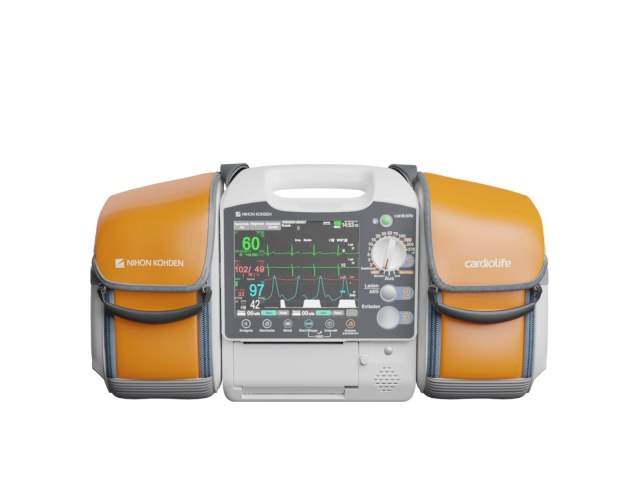
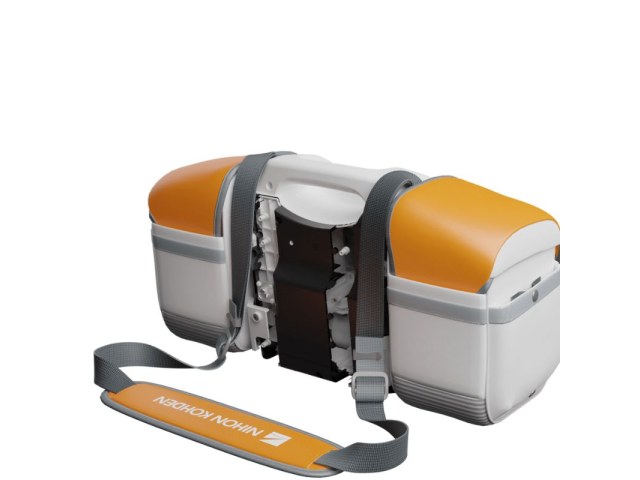
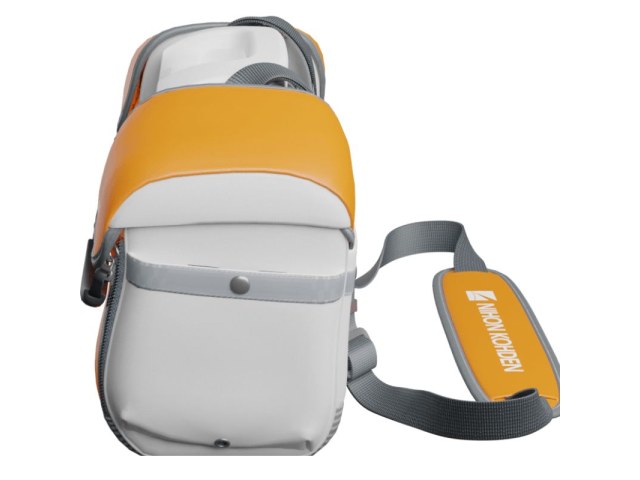
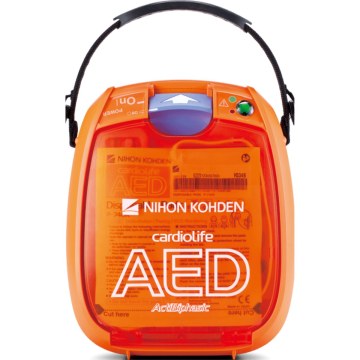
Features (Cardiolife EMS-1052 Monitor-Defibrillator by Nihon Kohden)
The user interface combines a touch display with a control dial, supporting fast operation with clear, structured steps in demanding environments.
It supports monitoring such as ECG, SpO2, CO2 and NIBP, with configuration-dependent expansion options to match different workflows.
synECi18 enables a synthesized 18-lead view derived from a 12-lead ECG, without requiring additional lead sets in the field.
A built-in thermal printer supports immediate printouts, while data transfer options help with documentation and archiving in clinical systems.
The unit is designed for challenging conditions, featuring dust & water protection (IP55) and a wide operating temperature range for transport and field use.
A range of compatible accessories & consumables (e.g. defib pads, patient cables, printer paper) allows the system to be tailored to the intended use scenario.
Technical Specifications
- Manufacturer: Nihon Kohden
- Model / MPN: Cardiolife EMS-1052
- Device type: Monitor-defibrillator (Manual & AED modes, synchronized cardioversion, external pacing)
- Display: 6.5" touch display
- Weight: 4.2 kg (with one battery)
- Ingress protection: IP55
- Operating temperature: -20 to 50 °C
- ECG: 3-lead up to 18-lead (via synthesized synECi18 view)
- Monitoring parameters (configuration-dependent): SpO2, CO2/etCO2 (capnography), NIBP, IBP, TEMP, cardiac output
- Printing: built-in thermal printer, 110 mm paper width
- Drop test: up to 1.22 m
- GTIN: Not available
Designed to meet international safety requirements for medical devices. Certification documentation (e.g. CE & ISO) should be verified via the manufacturer and/or the official distributor.
Frequently Asked Questions (FAQ)
What is the practical benefit of synECi18 compared to a standard 12-lead only workflow?
synECi18 adds synthesized leads on top of a 12-lead ECG, offering a more comprehensive view when required, without adding extra lead sets in the field.
When is capnography (etCO2) useful on a portable unit like the EMS-1052?
etCO2 monitoring supports a continuous respiratory picture and structured documentation during emergency management, especially when trending and reporting are important for the workflow.
Why does IP55 and drop testing matter for pre-hospital or transport environments?
In challenging conditions, dust & water protection (IP55) and drop testing help reduce downtime risks from environmental stress, while low weight and the built-in printer support smoother on-scene documentation.