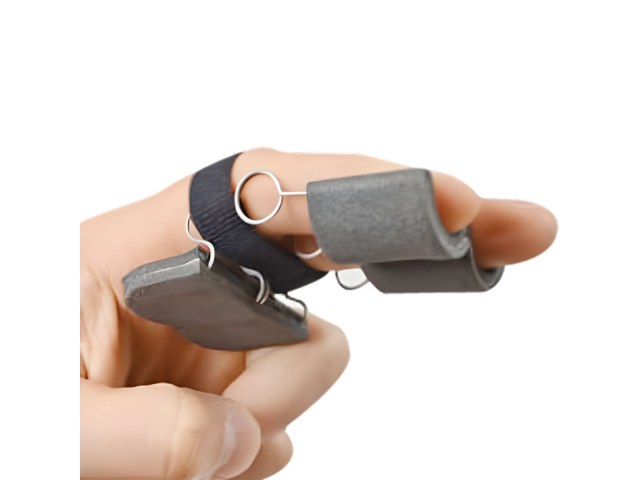
The Double Armchair Finger Splint is a dynamic two-finger splint designed for adjacent fingers (index & middle or middle & ring), helping keep the PIP joint in extension while still allowing active flexion for everyday functional use.
Features (Double Armchair Finger Splint)
The design supports two adjacent fingers, such as index & middle or middle & ring, when paired stabilization is preferred.
A supportive spring/insert element assists the PIP joint in extension, helping keep a more open finger position.
It allows active flexion, so the user can still perform basic finger movements during daily tasks.
The dynamic concept can be useful when a more controlled range of motion is preferred compared with a fully rigid splint.
The profile is practical for daytime use when you want support without fully locking finger movement.
Technical Specifications
Type: Dynamic double finger splint.
Application: two adjacent fingers (e.g., index & middle or middle & ring).
Target joint: PIP (assisted extension) with active flexion allowed.
Sizing reference: PIP joint circumference (cm).
MPN/Code: 03-2-099.
Certifications: compliant with international safety standards and carries CE and ISO certifications for reliable use, as stated on the packaging and/or manufacturer documentation.
- Small: PIP circumference 5.5–6 cm
- Medium: PIP circumference 6–6.5 cm
- Large: PIP circumference 6.5–7 cm
- X-Large: PIP circumference 7–7.5 cm
Frequently Asked Questions (FAQ)
When does a double splint (Double Armchair) make more sense than a single finger splint?
A double splint is practical when you want to support two adjacent fingers together, which can distribute contact and feel more stable during movement. A single splint is more focused on one finger but does not provide the same paired stabilization.
What does “PIP extension with active flexion allowed” mean in real use?
It means the splint helps keep the PIP joint in a more open extension position, while still allowing you to flex actively. This can feel more functional in daily tasks compared with fully rigid designs that block movement.
How do I choose the right size to avoid slipping or pressure?
Measure the PIP joint circumference where the splint sits and select the matching range. If you are between sizes, aim for a secure fit without strong pressure marks after use.