
AED: Having One Is Not Enough — It Must Be Ready
In this guide
When an AED is needed · Choosing a device · Installation · Costs and readiness · KIDS SAVE LIVES · FAQs
What does a defibrillator do, and when is it needed?
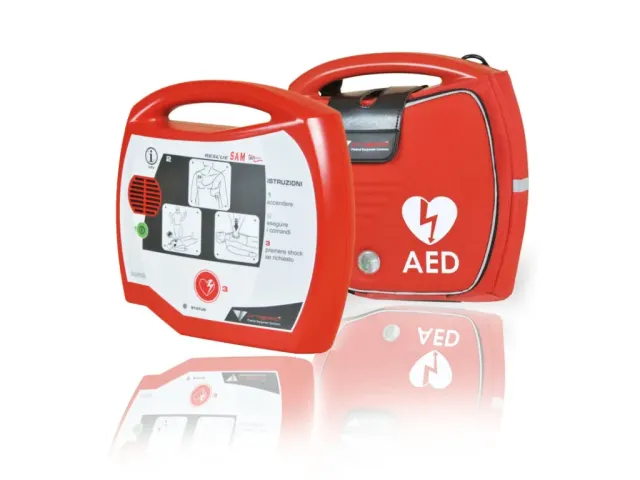
An automated external defibrillator (AED) is a portable device that assesses the heart’s rhythm. If it identifies a rhythm that requires defibrillation, it enables or delivers an electric shock. Voice prompts and visual instructions guide the person using it.
During cardiac arrest, the heart is no longer pumping blood effectively. This differs from a heart attack, in which blood flow to part of the heart is blocked. A heart attack can cause cardiac arrest, but the terms describe different conditions.
An AED is used in suspected cardiac arrest. It is not a preventive treatment for a conscious person reporting chest pain. Chest pain can also be an emergency and requires an immediate call for medical help.
Read more: American Heart Association: heart attack and cardiac arrest.
Can I use an AED without being a healthcare professional?
Yes. AEDs are designed to guide people who have no medical background. The user does not need to interpret the heart rhythm or independently decide whether a shock is required. The device performs that assessment.
Practising CPR and AED use can help you respond with greater confidence. However, a lack of training should not stop you from using an available AED during cardiac arrest. Follow the device’s prompts and the emergency call handler’s instructions.
The 2025 Basic Life Support guidelines emphasise public use of AEDs and the importance of responding promptly.
If an adult collapses
First make sure it is safe to approach. If the person is unresponsive, call 112 or 166 immediately in Greece, put your phone on speaker and assess breathing with guidance from the emergency call handler.
If the person is not breathing normally, start CPR. Ask someone else to bring the AED. When it arrives, switch it on and follow its prompts. Nobody should touch the person while the AED analyses the rhythm or delivers a shock.
Fully automatic or semi-automatic: what is the difference?
Both types assess the rhythm automatically. The difference is how the shock is delivered:
- Semi-automatic: if defibrillation is indicated, the device asks the user to press the shock button.
- Fully automatic: the device warns everyone to stand clear, then delivers the indicated shock without the user pressing a shock button.
The choice depends on the location, the likely users and how the emergency response is organised. Automatic operation does not remove the need for CPR or for following safety prompts.
What to check before buying
- Clear instructions: confirm the languages provided with the specific device configuration.
- Paediatric use: does the device require a switch, a special key or separate pads?
- Readiness indicator: how does it alert you to a fault or a low battery?
- Support: who handles technical issues, and how readily available are the correct replacement supplies?
- Package contents: are the battery, pads, carry case and patient preparation kit included?
For a child, use the appropriate paediatric mode or pads when available. Searching for special equipment must not delay defibrillation. Follow the AED’s instructions and guidance from the emergency service.
Useful guides: BHF: choosing a defibrillator and RCUK: paediatric resuscitation.
Defibrillators and AED signage at BIOMED
Explore examples of devices and equipment for setting up an AED point. Start with the needs of your premises.
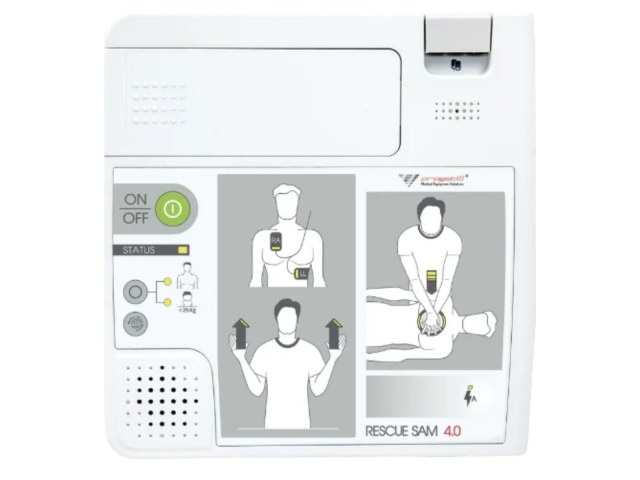
Progetti RESCUE SAM 4.0
Fully automatic operation with universal adult/paediatric pads. Check the available languages, patient selection controls and the configuration included in your quotation.
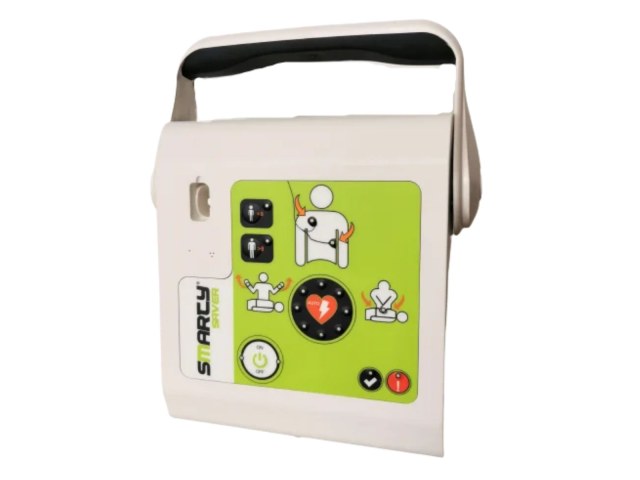
AMI Italia SMARTY SAVER
A fully automatic version with Greek voice prompts and adult/paediatric operation. Confirm the compatible pads, the supplied battery and the languages available for your intended users.
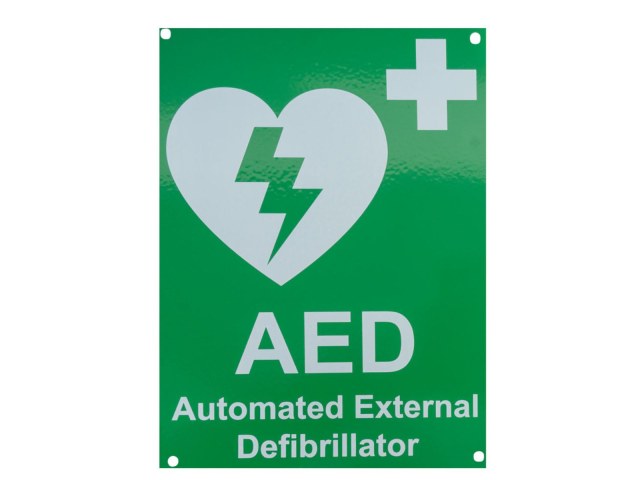
AED location signage
A recognisable green sign helps visitors locate the defibrillator. Position signage where people will see it along the actual routes to the device.
Where should an AED be installed: indoors or outdoors?
Think of a visitor who does not know the building. Can they find and collect the AED quickly? Closed shutters, locked doors and difficult-to-spot locations can restrict access.
- Indoors: choose a visible location near an entrance or reception, accessible to visitors, with clearly stated access hours.
- Outdoors: access may remain available when the building is closed, provided the equipment is properly protected.
The word “external” does not mean that an AED is suitable for permanent outdoor storage. An IP rating alone cannot establish whether it can remain outdoors throughout the year. Outdoor installation requires a suitable cabinet and conditions within the manufacturer’s specified temperature limits for the device, battery and pads. Consider cold weather, direct sunlight, overheating and moisture.
Should the AED cabinet be unlocked?
Resuscitation Council UK recommends unlocked cabinets that allow immediate access, avoiding delays while someone finds a key or code. A door-opening alarm can provide an alert without preventing collection. This is an accessibility recommendation, not a statement of a universal legal requirement in Greece.
AED location signage helps people find the equipment. If you are considering an alarmed AED cabinet, confirm that it suits the intended installation: an alarm does not establish weather resistance.
Read more: RCUK’s recommendation on AED cabinets.
What does owning a defibrillator actually cost?
A useful comparison of quotations considers purchase, installation and care over the years. Devices with similar purchase prices may have different replacement supply costs.
- Battery and pads: cost, replacement intervals and the expiry dates of the items actually supplied.
- Paediatric accessories, where required by the model.
- Cabinet, signage and any electrical installation or ongoing power costs.
- Staff training and replacement of supplies after use.
The British Heart Foundation explains the total cost of ownership. At BIOMED, you can request a quotation for the combination you need, including compatible replacement supplies.
Why do unused electrode pads have an expiry date?
The gel changes over time, affecting adhesion and contact with the skin. Pads therefore need replacement when they expire and after use, and should remain sealed until needed. Check compatibility against the exact model and part number, not just the brand.
Are automatic self-tests enough?
Self-tests can detect certain problems, but someone still needs to monitor the indicators. Appoint a responsible person and a deputy, and keep a simple record of checks performed according to the user manual.
- Readiness indicator and battery status.
- Pad expiry dates, packaging and connection, as specified for the model.
- Access, signage, cabinet condition and visible damage.
- Scissors, a towel, gloves, a razor and an appropriate ventilation barrier device.
After an emergency, the equipment needs checking and restoring to a ready state. If the AED is moved, used or taken out of service, update its registered location and availability as well.
KIDS SAVE LIVES: knowing where to find an AED
KIDS SAVE LIVES develops the National AED Map and provides resuscitation training programmes. The initiative connects the provision of equipment with community awareness and engagement.
Registration requires the precise location, access instructions, available hours, the responsible person’s details, and information about the battery and pads. An AED kept inside a shop can also be registered, with its actual access hours. A device behind a closed entrance should not be listed as accessible 24/7.
Useful links for individuals and businesses
Find an AED on the KIDS SAVE LIVES map →
Register the AED at your premises →
iSAVElives offers navigation to AEDs and guidance tools. Familiarise yourself with it beforehand: in an emergency, calling for help and starting CPR take priority. Do not delay these actions to install an app. Some linked KIDS SAVE LIVES resources are in Greek.
Frequently asked questions
If the AED says “no shock advised”, is the person OK?
Not necessarily. It means the device has not identified a rhythm requiring defibrillation. If the person remains unresponsive and is not breathing normally, immediately resume CPR, following the AED’s prompts and the call handler’s instructions.
Does an AED replace CPR?
No. CPR and an AED work together. Do not wait for the device to arrive before starting compressions. Pause for rhythm analysis and shock delivery when instructed, then resume immediately as directed.
What if the person’s chest is wet?
Dry the chest so the pads can adhere properly to bare skin. Make sure it is safe to approach and follow the manufacturer’s instructions. Nobody should touch the person during rhythm analysis or shock delivery.
Is an AED used in the same way on women?
Yes. The priority is correct pad placement on bare skin, following the illustrations on the pads. Move or remove clothing that obstructs placement. Embarrassment should not delay emergency care.
Can an AED trainer be used to treat cardiac arrest?
No. An AED trainer simulates operation for practice and cannot deliver a therapeutic shock. Store and label it so it is clearly distinguishable from the real AED intended for emergencies.
A practical readiness check for your premises
Ask a colleague: “Where is the AED, and how do we collect it right now?” Walk the route, check access and confirm who monitors the replacement supplies. A short practical exercise can reveal obstacles that a purchase quotation will not show.
At BIOMED Serres, you can discuss the needs of your premises and learn about AEDs, storage equipment, signage and compatible replacement supplies.
Explore AEDs and related equipment at BIOMED →
42 Ethnikis Antistaseos, Serres, Greece · +30 23210 28135
Sources and further reading
This guide draws on official resuscitation and public information resources. For the technical requirements of each device, follow the manual for that exact model.
- European Resuscitation Council — Guidelines 2025
- Resuscitation Council UK — Public access defibrillators: a guide for communities
- British Heart Foundation — Defibrillator FAQs
- British Heart Foundation — Your guide to being a defibrillator guardian (PDF)
- St John Ambulance — Guide for first-time AED buyers
- EKAB — First aid handbook (Greek PDF)
Sources checked: 24 October 2026. This article provides general information and does not replace practical training or instructions from the emergency service. Some international sources mention emergency numbers for other countries; in Greece, call 112 or 166.
